PythonBeta
CogniMax
A chess engine that plays to beat a specific opponent quickly. It predicts how a player at a given rating is likely to reply and picks the move with the best expected result, instead of assuming the opponent plays perfectly.
Result
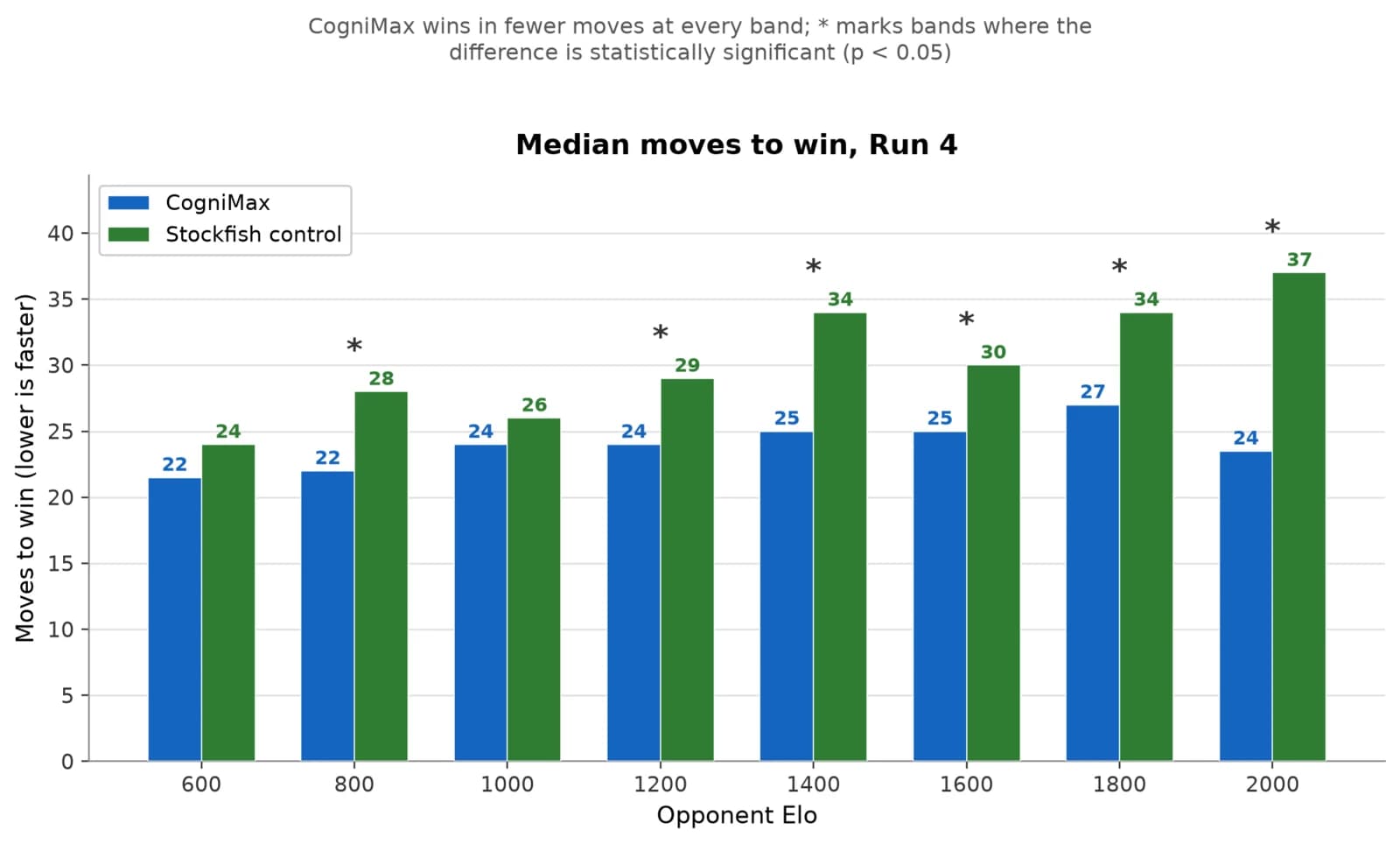
Across 4,120 games against a human-like opponent at 11 ratings from 600 to 2600, CogniMax won in a median of 22 moves, versus 27 for Stockfish searching to the same depth. It won faster at every rating (up to 31% fewer moves at 2400) and lost no games.
Built with
- Python
- PyTorch
- python-chess
- Stockfish
- maia3
- pandas
- SciPy
- statsmodels
The problem
Engines like Stockfish assume the opponent always finds the best reply. Against a real 1200-rated player that wastes chances, so games drag on. Training bots and game AI that play at a person's level need an engine that takes the opponent's likely mistakes into account. Put simply, the best move in general is not always the most effective one. When your opponent has a weak spot, going after it usually works better (like punching someone where they're already hurt, or a better example lol).
What I built
Research intern at the IC2 Lab, KMUTT, June to July 2026. I built the engine, designed and ran the experiments, and wrote the statistics and the scripts that recompute every number in the report from the raw games.
How it works
- Stockfish at depth 8 proposes CogniMax's candidate moves and scores the positions.
- maia3, a neural network trained on human games, predicts how likely the opponent is to play each reply at the target rating.
- A 3-move-deep expectimax search combines the two and picks the move with the best expected result. A setting controls how much risk it takes.
- In every game the opponent is maia3 at the target rating, picking moves the way a person at that level would.
Key decisions
- 01
Win speed as the main measure
Both engines won nearly every game, so the useful question was how fast each one wins.
- 02
Statistics that hold up
Bootstrap A/B tests, Holm-corrected paired tests, power analysis, and survival models, plus scripts that check every claim in the report against the raw data.
By the numbers
- CogniMax: 2,056 wins, 4 draws, 0 losses. Stockfish: 2,030 wins, 30 draws, 0 losses.
- Its chance of winning by any given move was 1.5 times Stockfish's at rating 600 and 2.9 times at 2400.
- About 30,500 lines of Python for the engine, experiments, analysis, and report.
What I learned
How important it is to document everything and make sure everything can be reproduced. And to write a clear hypothesis and main goal before running anything.
Limits
The gain is for engines limited to a shallow search. CogniMax thinks about 4.4 seconds a move against Stockfish's 30 ms, and a Stockfish given the same time wins at least as fast. A reply predictor built from Stockfish alone also did as well as maia3, which the report treats as its main finding.